BATCH-5138 · filed
Fermented macadamia nut oil enters INCI conversation as self-emulsifying ingredient
A Nature study characterizes self-emulsifying macadamia nut oil fermented by skin-flora bacterium E. keratini mutant EPI-7-i, framing a novel cosmetic ingredient route.
By James Calloway · · 3 min read · 585 words
Composition
- Nature-published study characterizes self-emulsifying macadamia nut oil as a novel cosmetic ingredient
- Fermenting microorganism is Epidermidibacterium keratini mutant EPI-7-i, originating from human skin flora
- The fermented oil self-emulsifies, positioning it to reduce conventional emulsifier load in formulations
- Macadamia nut oil is an established INCI-listed emollient; the fermentation route adds novel functionality
- Commercial adoption awaits supplier uptake, safety assessment and INCI designation
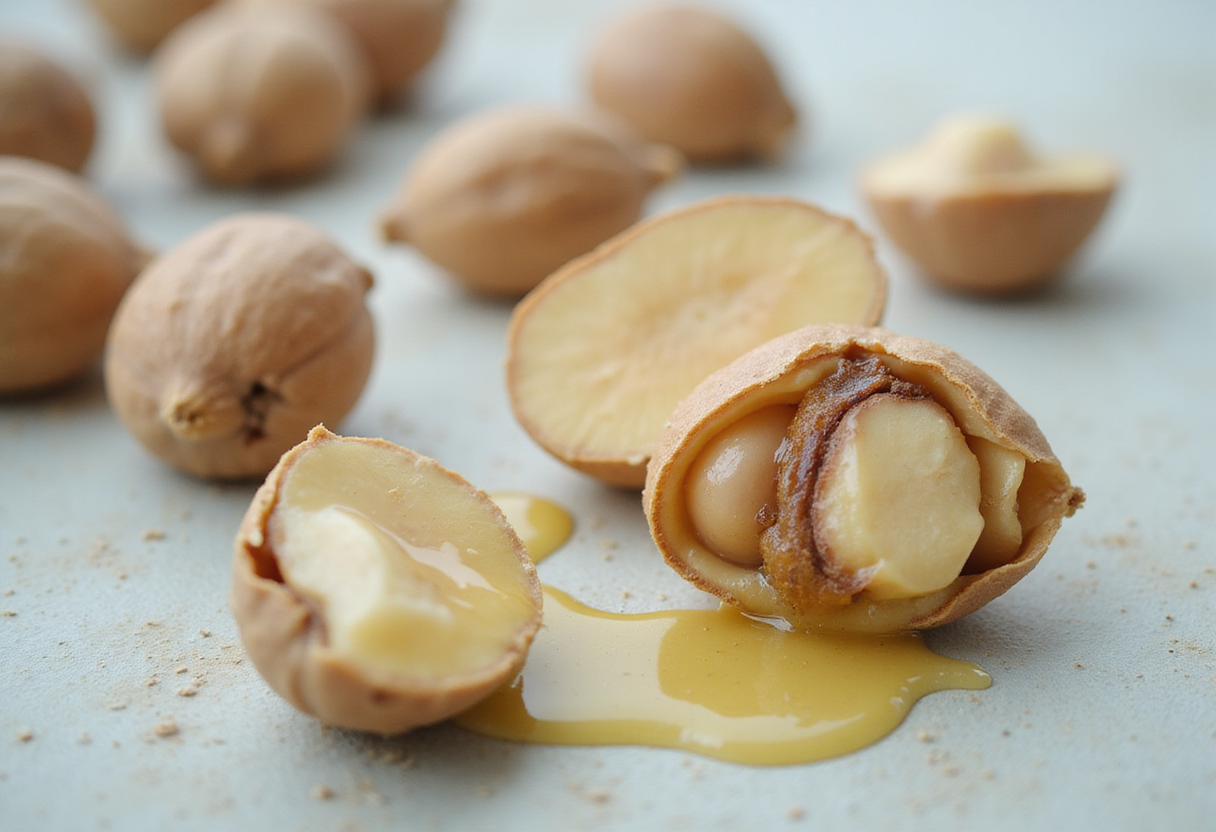
A study published in Nature characterizes a self-emulsifying macadamia nut oil fermented by Epidermidibacterium keratini mutant EPI-7-i, a microorganism originating from human skin flora, as a novel cosmetic ingredient.
The paper's subject sits at the intersection of two formulation trends formulators will recognize immediately: fermentation-derived actives and self-emulsifying oil systems. Its novelty rests on the pairing of the two — a plant oil modified by a skin-derived bacterium so that it emulsifies without conventional surfactant assistance.
Why the microorganism matters
Epidermidibacterium keratini is a skin-flora bacterium. The strain used here is a mutant designated EPI-7-i. Fermentation by skin-commensal organisms has become a credible route to cosmetic ingredients because the resulting metabolites align with the skin's own biochemistry — a positioning familiar from probiotic and postbiotic ingredient launches across the past several formulation cycles.
Using a mutant strain rather than the wild-type organism signals a deliberate production optimization step: the supplier or research team selected a variant whose fermentation output gives the oil its functional character. For procurement teams tracking biotech-derived ingredients, the mutant designation matters for documentation — strain identity will feature in the safety and manufacturing dossiers.
What self-emulsifying behavior changes in the lab
Macadamia nut oil is already an established INCI-listed emollient, valued for its palmitoleic acid content and skin feel. Its limitation is the one shared by all fixed oils: it requires an external emulsifier system to incorporate into creams and lotions.
A self-emulsifying version of the oil changes that equation:
- Formulators can reduce or restructure the surfactant load in emulsion formulas
- The oil phase carries part of its own stabilization workload, potentially simplifying ingredient decks
- Simplification supports clean-label and shorter-INCI-list claims that brands increasingly request
Any reduction in conventional emulsifier content also touches sensory profiles and preservation strategy — the trade-offs formulators will need to verify against the published characterization data.
What "characterization" means for adoption
The study's framing as a characterization paper — rather than a launch announcement — tells the market where this ingredient sits in its lifecycle. Characterization work typically establishes identity, physicochemical behavior and emulsification performance of the fermented oil before commercial safety assessment and regulatory notification begin.
For an ingredient derived from a fermentation process involving a mutant microorganism, the compliance pathway includes questions formulators should anticipate:
- Residual biomass and metabolite profiling of the fermented oil
- Documentation of the mutant strain and its production behavior
- Standard cosmetic ingredient safety assessment before INCI assignment and market entry
None of these steps is unusual for biotech-derived cosmetic inputs, but each adds documentation workload compared with a straightforward plant-oil supply.
Who should watch this
The development is relevant to three professional audiences:
- R&D and contract formulators evaluating fermentation-derived emollient systems with reduced emulsifier dependence
- Regulatory and quality teams planning dossiers for microbially processed ingredients
- Procurement specialists tracking novel oil platforms that may reach suppliers' catalogs once safety data matures
The skin-flora origin also gives marketing teams a scientifically grounded narrative — an ingredient produced by a bacterium from the skin's own microbiome acting on a premium nut oil — without requiring probiotic-type claims that face tighter scrutiny in several jurisdictions.
What comes next
The data point to watch is a supplier picking up the EPI-7-i fermented oil platform and moving it through INCI designation and safety assessment toward a commercial launch — the step that would convert this characterization study into a line-item on formulation sheets.
via Google News - Cosmetic Ingredient (Source)
More from James Calloway
Cross-references · Related articles
- Wiley Review Pressures 'Microbiome-Friendly' Cosmetic Claim Category
- Estonian startup ÄIO brings fermentation-derived oils to cosmetics with tilk! launch
- Cultured Human Skin Cells Surface as K-Beauty's Newest Active Class
- Abolis Biotechnologies launches platform for microbial cosmetic ingredients
- Polish researchers unveil microcapsules that keep probiotics alive in cosmetics
End of monograph · 3 min read